
QHSE in Ship Management: The Work That Happens Between the Screens
Quality, health, safety and environment meet in the decisions that pass between the office and the vessel. A short review can make the unresolved ones visible before the next operation.
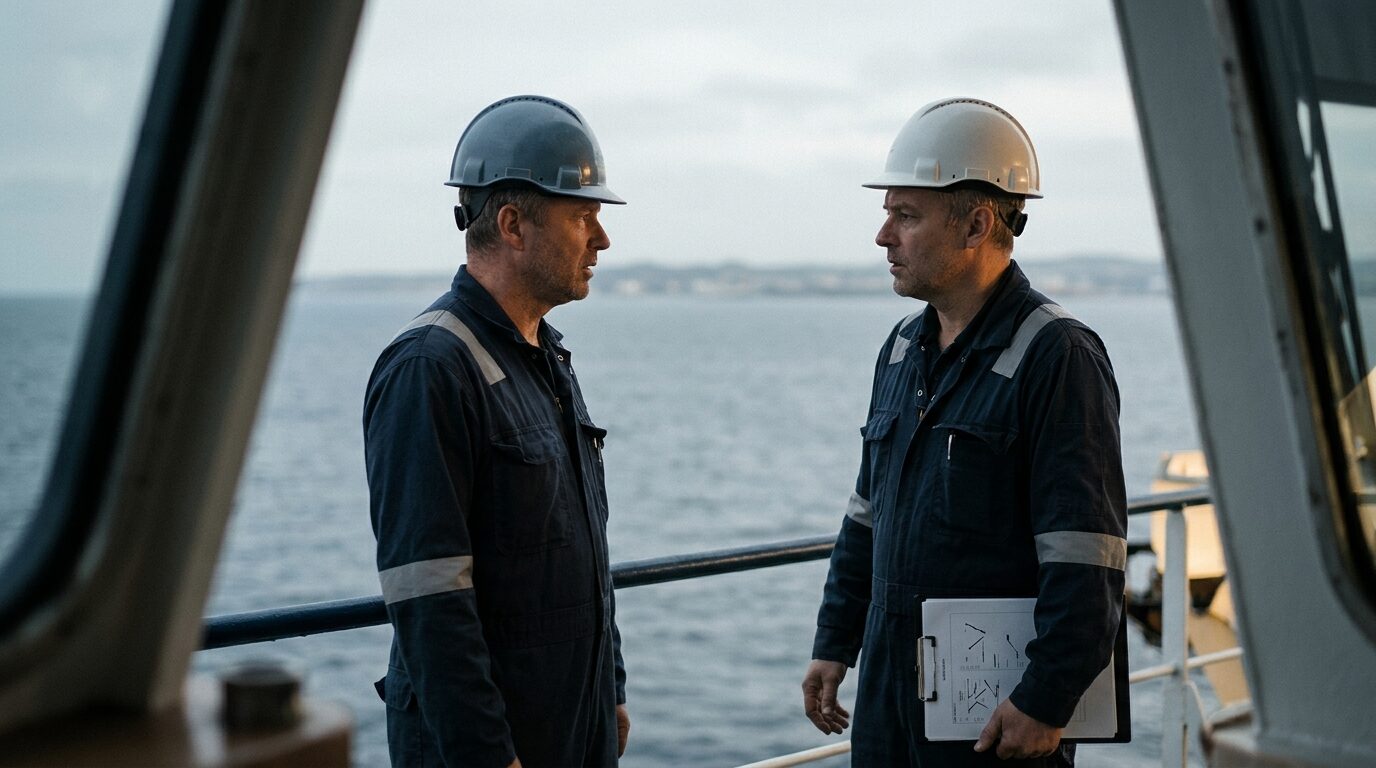
QHSE in ship management is often described as a department, a set of certificates or a monthly report. In practice it is a sequence of decisions made at the boundary between commercial pressure and operational control. A voyage instruction that leaves too little margin. A maintenance item deferred to the next port. A crew change that takes a familiar chief engineer off a ship at a difficult moment. A procedure revised in the office that no one on board has yet used.
Those decisions rarely look like safety decisions when they are made. They look like scheduling, budgeting and administration. The QHSE function exists to make their consequences visible before they become findings, detentions or casualties — and to make sure that when something does go wrong, the company can show what it knew, what it decided and what it changed.
The difficult part is coordinating those decisions across shifts, departments and time zones. Document control, maintenance systems and reporting dashboards can help, provided the next person can find the outstanding question, the evidence and the person authorised to act. That is a useful starting point for a weekly ship-and-shore review.
Four disciplines, one operational reality
The letters are usually treated as four workstreams. Operationally they are four lenses on the same decisions.
- Quality asks whether the work is done consistently and whether the evidence is trustworthy. In ship management it is the difference between a procedure that exists and a procedure that is followed by a relief officer on a dark morning.
- Health asks how the work affects people over time: fatigue, exposure, welfare and the conditions in which they live and work. The review needs the relevant operational evidence while protecting personal medical information.
- Safety asks what could injure someone and whether the controls hold under time pressure. Permits, risk assessments, toolbox talks and stop-work authority depend on people being able to question the job before proceeding.
- Environment asks what leaves the ship and how it is recorded. Discharges, emissions, waste handling and fuel decisions are operational choices with regulatory consequences attached.
Security may sit alongside these responsibilities, with its own requirements. When the workstreams are managed as separate silos, each generates its own records and its own review cycle. The ship experiences them as competing requests for attention. The opportunity in QHSE ship management is to reduce that competition by connecting the records to the decisions they were meant to support.
Four ship-and-shore handovers worth checking
The instruction seam
Consider a procedure written in the office, approved by a manager, published to the fleet and acknowledged on board. Then a superintendent finds that the crew has developed a workaround because the procedure does not fit the equipment fitted to that vessel. The acknowledgement record may be genuine, but it does not establish that the procedure can be used safely.
The review needs to establish how the mismatch arose. Was the vessel consulted? Did the equipment change? Was feedback raised but left unanswered? Those possibilities lead to different corrective actions.
The commercial seam
Every ship manager operates under commercial constraint. That is not a defect; it is the environment. The risk arises when a commercial decision quietly changes the operational risk profile without anyone recording the trade-off. Deferred maintenance, reduced spares, tighter port rotations and minimal manning all have safety consequences. If those consequences are never written down, the company cannot show that it considered them.
The reporting seam
Near misses, defects and concerns can lose detail as they pass from vessel to office. A report may be recategorised, combined with another item or summarised for management. Check whether the original concern remains visible and whether the person who raised it received a useful response. A quiet reporting period deserves a question, not an automatic green status.
The change seam
A procedure changes, a form is revised, a new equipment standard is introduced. The document control system shows the current version. The vessel shows the previous practice. In between is a period in which no one can say with confidence which instruction applies. Change control is one of the least glamorous parts of QHSE and one of the most reliable indicators of whether the system is real.
What actually holds a QHSE system together
There is no single control that fixes the seams. There is a set of routines that make them visible.
Short, owned open-item reviews. A weekly review can complement the monthly dashboard by examining unresolved items, their owners and their next decision dates. Ask what is blocking the action and whether the current controls remain adequate.
Ship visits that test the records. Use the required checks alongside questions: what has changed since the last visit, what is not working, what have you stopped doing? Then compare the answers with the controlled instructions and the work itself.
Change control that reaches the practice. Every revision should have a named person who confirms that the change has been understood and applied, not just distributed. Keep evidence of how that was checked, proportionate to the significance of the change.
Triage that sets the right response. Decide the urgency, scope and ownership of follow-up through the SMS, preserving applicable reporting and investigation requirements. Categorisation should help the issue reach the right person, with the original concern still visible.
Management review with decisions. Record what changes, what resources are needed, who is responsible and when effectiveness will be checked. An internal risk-acceptance decision cannot waive an applicable requirement or the master's authority.
A weekly review the next watch can use
The following is a suggested operating routine, not a regulatory meeting interval. It supports the responsibilities addressed in the ISM Code, including company and master responsibilities in sections 3 and 5, reporting in section 9 and review in section 12. Urgent hazards belong in the immediate escalation process; they must not wait for the weekly call.
- Prepare one short list. Bring forward unresolved safety-critical defects, repeat findings and changes that affect the next voyage or port operation. Link to the controlled records rather than copying them into another register.
- Hear the vessel first. Ask what has changed since the previous review and whether the office's account matches the condition on board. Record disagreement as an open question.
- Make the next action specific. For each item, identify an accountable owner, the evidence needed, the decision deadline and who can resolve a resource or authority blockage.
- Test the proposed closure. Separate the completion of a repair or briefing from verification that it worked. Record who will perform that check and under what operating conditions.
- Confirm the handover. Read back the decisions, restrictions and escalation triggers. The relief officer and duty superintendent should be able to follow them without attending the call.
Illustrative review entry, not a real vessel case: a revised isolation procedure has been acknowledged, but the vessel reports that its equipment labels do not match the drawing. The technical superintendent owns the drawing check; the chief engineer supplies the controlled drawing reference and a record of the mismatch. The item stays open pending a vessel-specific review and verification by the authorised personnel. Before the affected job is planned, the master and superintendent confirm the safe arrangement under the company's procedures. If it cannot be established, the job does not proceed and the issue goes through the designated escalation route. A signature acknowledging receipt would not close this item.
This produces a useful weekly output: a small set of decisions that the next watch can act on, with uncertainty and restrictions still visible.
Where AI fits into that review
The current wave of AI tools is useful in the parts of QHSE work that are drafting, summarising and comparing. It can turn a set of inspection findings into themes, draft a first version of a briefing, translate a procedure, or prepare a structured summary for management review. Used with a named reviewer and source material to check against, it can reduce the administrative load that keeps competent people away from the operation.
Three checks matter before using that output. Apply the same authorised review to an AI-assisted procedure as to any other controlled revision. Check a meeting summary against what was actually agreed before treating it as a decision record. And confirm that the proposed input, especially personal, medical or commercially sensitive material, is permitted in the chosen tool under the company's controls.
These are recommended AI working controls, not a new statutory approval regime. Apply the company's information-handling rules, document controls and existing responsibilities. The free What Maritime QHSE Teams Should Never Paste Into AI Tools guide supports input review; its listing explains how to request a copy. Where a change also needs a crew briefing, Training And Drill Scenarios provides prompts with best-use and review cautions, not ready-approved training material. Assess every draft against the vessel, task and controlled procedures.
If the weekly review repeatedly stalls because nobody can locate the supporting record, consider the Audit And Evidence Readiness Kit. Its guide and editable audit tools support evidence organisation alongside existing records. Confirm scope, availability and delivery through the enquiry listing; a workbook cannot verify the condition on board.
A practical test of QHSE maturity
If a new superintendent joined tomorrow, could they understand within a week how this company manages risk at sea? Not the organisation chart — the actual mechanism. Which decisions are made on board, which are escalated, how a concern travels, who can stop a job, how a change is verified, what happens when a finding recurs.
If the answer depends on one experienced person's memory, the system is held together by that person. If the answer depends on a software suite, the system is held together by configuration. A resilient QHSE function depends on neither alone. It depends on routines that produce evidence — short reviews, real visits, verified change, honest triage and decisions that can be traced.
That is also the honest boundary of what a product can do. Meriden's kits are editable working documents and briefing material designed to support those routines. They are not a management system, they do not certify anything, and they cannot substitute for the company's own verification. If you are assessing where your system is genuinely weak, the analysis on false assurance in maritime compliance and the examination of why the same safety findings keep coming back go into the underlying pattern in more depth.
Conclusion
QHSE in ship management is not a reporting function. It is the discipline of keeping the consequences of decisions visible while there is still time to change them. The records, dashboards and platforms are instruments. They become valuable when they shorten the distance between a question and the evidence that answers it, and dangerous when they create the impression that the question has already been answered.
The measure of a good QHSE system is not how much it can display. It is whether the people closest to the work would tell you the truth about what is not working — and whether the company would act on it.
A management system is only as strong as the least convenient conversation it is willing to have.
References
- IMO: International Safety Management (ISM) Code and amendment history. Relevant sections: 3 and 5, company and master responsibilities; 6 and 7, resources and shipboard operations; 9, reporting; 11, documentation; 12, verification, review and evaluation. Read with the applicable amended Code.
- IMO resolution A.741(18), original ISM Code text. Use the amendment history above rather than treating the 1993 resolution alone as the current consolidated text.
- ILO: Maritime Labour Convention, 2006, consolidated text including the 2022 amendments, Regulation 4.3 and Standard A4.3, health and safety protection and accident prevention. Check applicable flag-State implementation and the ILO convention page for amendment status.